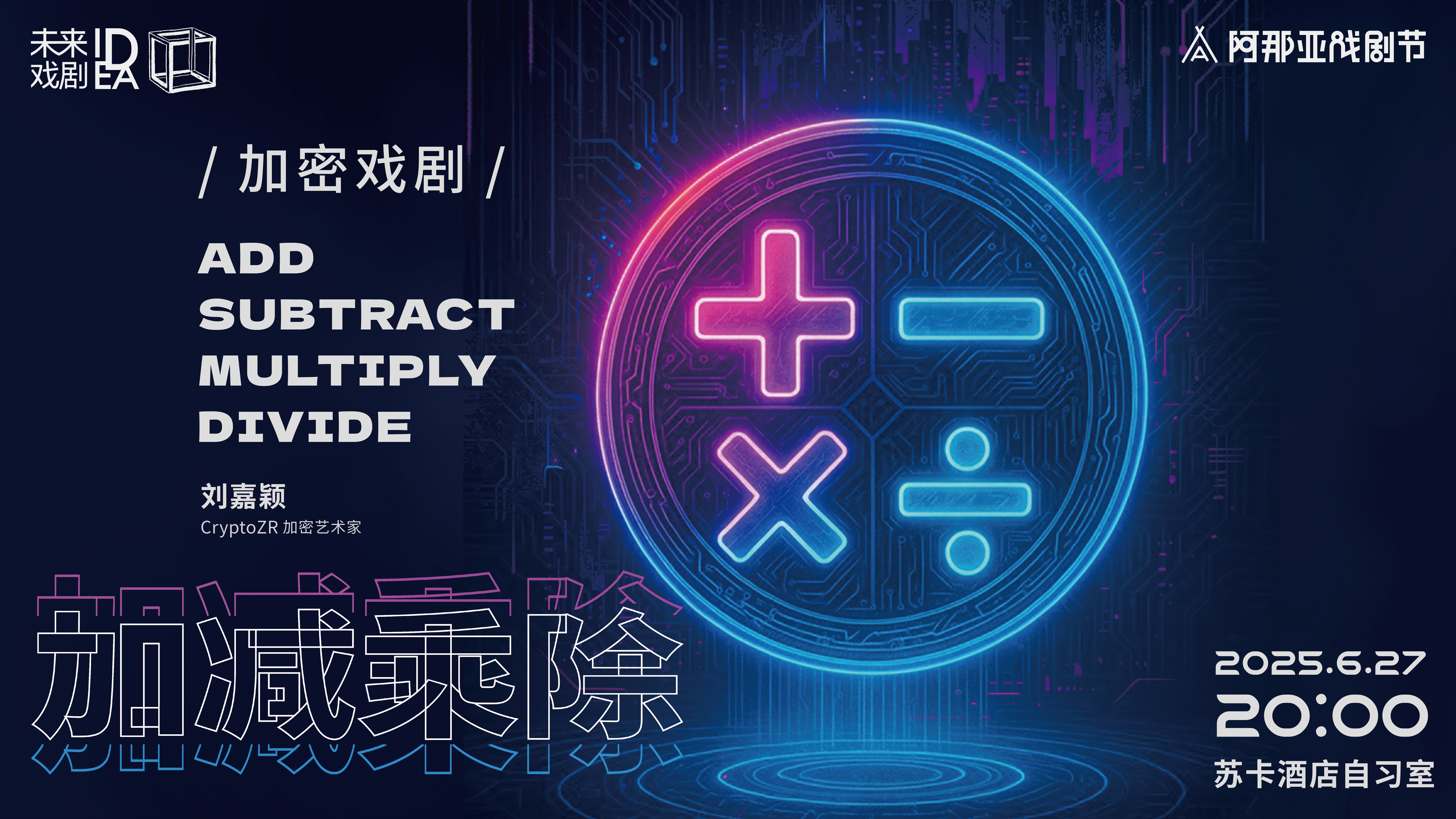
加减乘除
Add, Subtract, Multiply, Divide
2025
在阿那亚戏剧节,代币转账的加减规则之上增加了乘除法,通过偶发行为映射人性的贪婪与欺骗。
基本信息
- 艺术家:CryptoZR
- 创作年份:2025
- 创作平台:ZRChain(以太坊POA私有链)
- 创作材料:智能合约·戏剧
- 版本数:N/A
- 资产属性:ERC20
- 作品类型:跨界融合
作品介绍
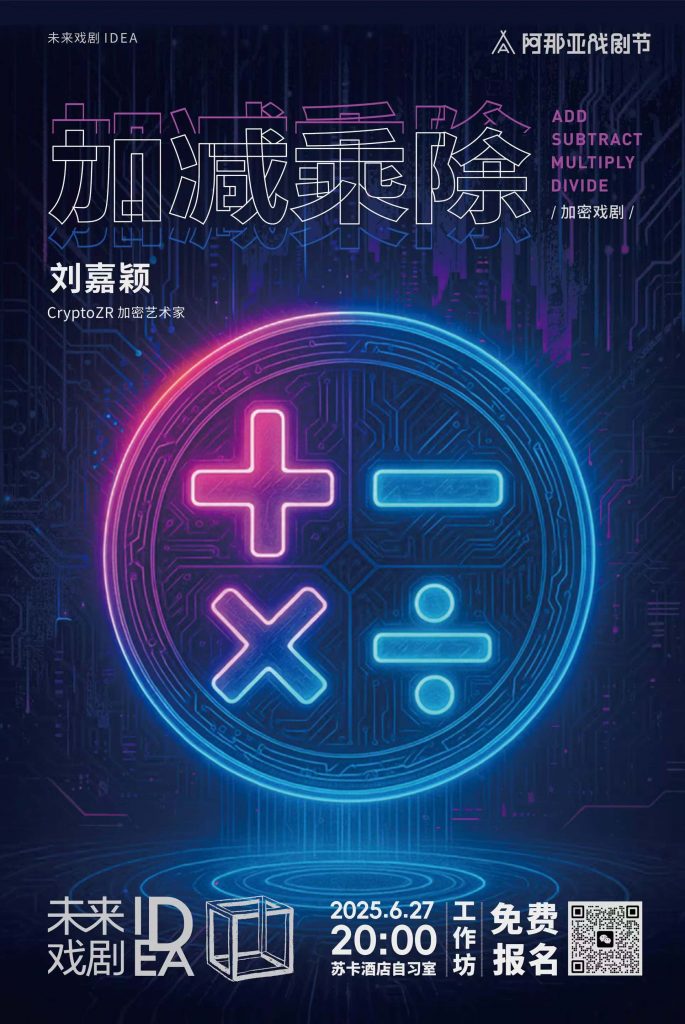
《加减乘除》是一个基于智能合约创作的新货币形态的艺术项目。传统的货币转账在本质上是账本的余额变动,即付款方的余额减少而收款方的余额增加,并且保持余额总量不变。艺术家在此基础上,增加了乘法与除法操作,在这个系统内的用户在转账时有可能将自己的余额与对方的余额进行加减乘除四种随机操作来更新双方余额,从而创造出一种新型货币形态。
技术介绍:为实现本作品,艺术家团队专门搭设了一条服务于艺术创作的私有链ZRChain,私有链基于以太坊POA机制搭建,其运行节点全部由艺术家团队运营,其上通证无任何经济价值。

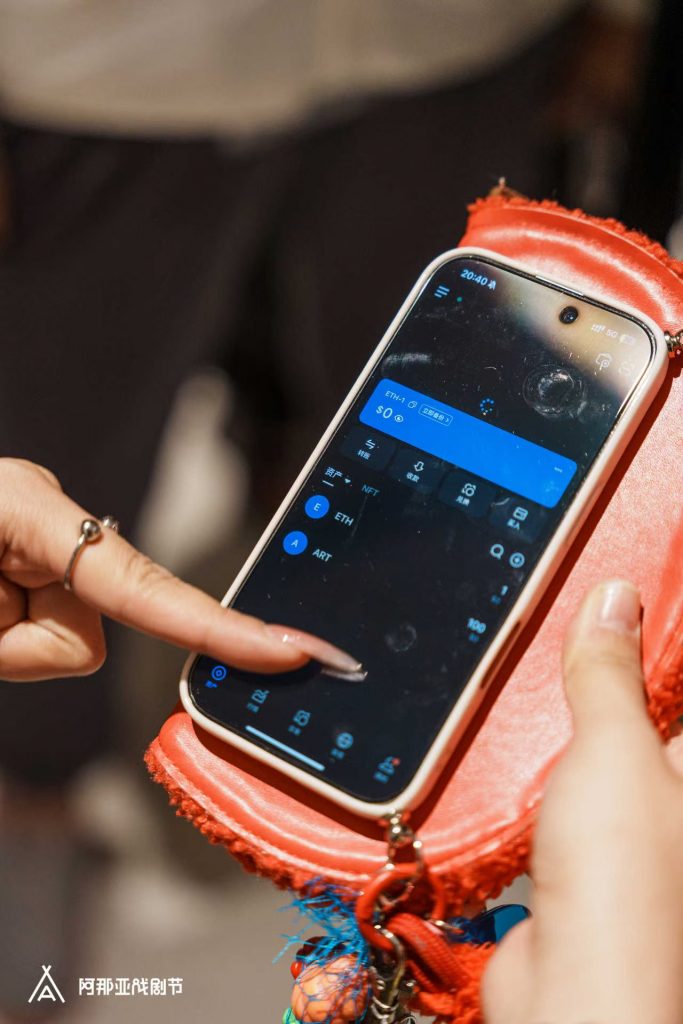
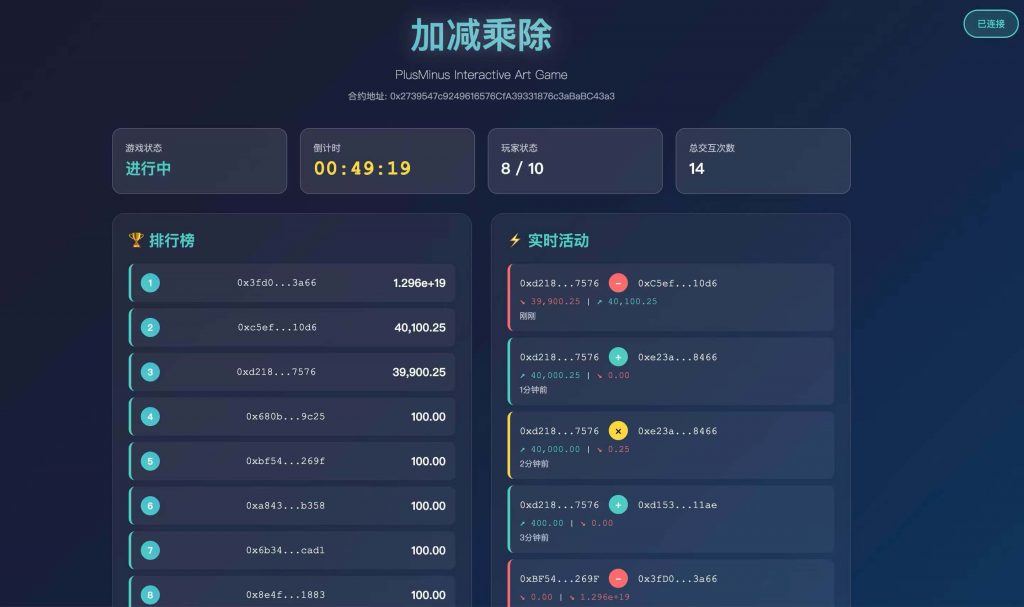
刘嘉颖的加密艺术作品"加减乘除"6月底在阿那亚戏剧节上演,邀请观众注册数字钱包,将钱包地址二维码打印并挂在胸前,参与互动的玩家通过扫描二维码互相转账,转账的规则是根据双方钱包余额随机触发"加减乘除"算法。
创作背景
2025年,CryptoZR受邀参与阿那亚戏剧节——中国最重要的沉浸式戏剧节之一,聚集了大量戏剧界和文化界核心创作者。艺术家意识到这是测试"加密货币行为艺术"的理想场域。
《加减乘除》(ASMD)由此诞生。艺术家团队专门搭建了私有链ZRChain(基于以太坊POA机制),为27位参与观众各铸造100枚代币,并通过智能合约实现随机运算机制:两人互扫二维码转账时,系统随机触发加、减、乘、除四种操作,更新双方余额。
游戏持续约两小时,实时排行榜在剧场内展示。最终获胜者钱包余额达约27.5京,通过一次被动转账反超成为第一。排名第二的是一位14岁初中生,她捡起一张废弃钱包地址二维码插在胸牌背面,用"假地址"参与互动——无意中实践了区块链的金句"Don't trust, verify!"(不要相信,去验证)。
创作理念
《加减乘除》将货币规则的重新设计作为艺术表达的核心:
-
传统货币的根本性颠覆:传统货币转账只有加减,总量守恒。ASMD引入乘法和除法,打破了货币守恒定律——价值可以在瞬间翻倍或归零。这是在真实社会实验中观察人类面对不确定性时的行为模式。
-
规则设计即创作:作品不生产"图像",而是设计"规则"。策展人李振华将这种野心类比为"神"的创造。CryptoZR通过代码重建了一个微型经济系统,让参与者在其中自然涌现出策略与行为。
-
行为数据的艺术价值:游戏结果揭示:赚到巨额财富后主动退出的人,以及用假地址保护资产的少年——这些自发行为是现实世界权力结构和信任机制的真实映射。
创作形式
作品以智能合约为规则引擎,以现场演出为表达形式,是行为艺术与区块链技术的融合。
技术架构:
- 专属私有链:艺术家团队搭建了ZRChain(基于以太坊POA权威证明机制),节点全部由艺术家团队运营,链上通证无任何经济价值
- 智能合约规则:自定义转账合约,每次两方互发转账时,系统随机选择加、减、乘、除之一,更新双方余额
- 互动载体:每位参与者拥有一个ZRChain钱包地址,将地址二维码打印并挂在胸前
- 实时排行:剧场内设大屏幕实时显示参与者余额排名
- 公平性设计:每人以100枚代币起始;随机算法确保无法预测操作类型
- 数据记录:全程链上记录所有转账操作,可追溯参与者的完整互动历程
作品评论
郭成 — 个人评论(阿那亚戏剧节现场观察),2025年6月
- 评论标题:加减乘除 不要相信,去验证
- 评论摘要:评论者指出《加减乘除》是真实世界运作规律的游戏模型,获胜者在积累巨额财富后主动退出是现实世界的映射。文章引用本雅明的闲逛者概念,并将第二名少女的假地址策略与区块链原则相类比。认为这是一种涌现的结果还是构建人类社会基础规则的开放性问题。
- 来源链接:https://cryptozr.net/?p=1636(作品页面内收录)
参展信息
1. 阿那亚戏剧节 2025
- 展出时间:2025年6月27日
- 展出地点:阿那亚,秦皇岛
- 主办方:阿那亚戏剧节
媒体报道
Basic Information
- Artist: CryptoZR
- Year: 2025
- Platform: ZRChain (Ethereum PoA Private Chain)
- Materials: Smart Contract · Theatre
- Edition: N/A
- Asset Type: ERC-20
- Category: Cross-disciplinary Fusion
Introduction
Add, Subtract, Multiply, Divide is an art project built on smart contracts that proposes a new form of money. A conventional monetary transfer is essentially a change of balances in a ledger: the payer's balance decreases and the payee's increases, while the total remains constant. On this basis the artist added the operations of multiplication and division, so that when users of the system make a transfer, one of four operations — addition, subtraction, multiplication or division — may be applied at random to their own balance and the other party's in order to update both, thereby creating a new form of money.
Technical note: to realise the work the artist's team built a private chain dedicated to artistic creation, ZRChain. The private chain is built on Ethereum's PoA mechanism, all its nodes are operated by the artist's team, and the tokens on it have no economic value whatsoever.
Liu Jiaying's crypto artwork "Add, Subtract, Multiply, Divide" was staged at the Aranya Theatre Festival at the end of June. Visitors were invited to register a digital wallet, print the QR code of their wallet address and wear it on their chest; players taking part in the interaction transferred to one another by scanning the codes, and the rule of transfer was that an "add, subtract, multiply, divide" algorithm was triggered at random according to the balances of the two wallets.
Background
In 2025 CryptoZR was invited to take part in the Aranya Theatre Festival, one of China's most important immersive theatre festivals and a gathering place for many of the central figures in theatre and culture. The artist recognised it as an ideal setting in which to test "cryptocurrency performance art".
Add, Subtract, Multiply, Divide (ASMD) was born from this. The artist's team built the private chain ZRChain (based on Ethereum's PoA mechanism), minted 100 tokens for each of the 27 participating visitors, and implemented a random-arithmetic mechanism through a smart contract: when two people scanned each other's QR codes to transfer, the system randomly triggered one of the four operations — addition, subtraction, multiplication or division — and updated both balances.
The game ran for about two hours, with a live leaderboard displayed in the theatre. The eventual winner's wallet balance reached roughly 2.75 × 10¹⁷, overtaking the field to take first place through a single passive transfer. Second place went to a fourteen-year-old middle-school student who picked up a discarded QR code of a wallet address and tucked it behind her own badge, taking part with a "fake address" — inadvertently putting into practice the crypto maxim "Don't trust, verify!"
Concept
Add, Subtract, Multiply, Divide places the redesign of monetary rules at the centre of its artistic expression:
-
A fundamental overturning of conventional money: conventional monetary transfer involves only addition and subtraction, and the total is conserved. ASMD introduces multiplication and division, breaking the law of monetary conservation — value can double or fall to zero in an instant. It is a real-world social experiment observing how people behave in the face of uncertainty.
-
Rule design as creation: the work produces no "image"; it designs "rules". The curator Li Zhenhua likened this ambition to the creative act of a "god". Through code CryptoZR rebuilt a miniature economic system in which strategies and behaviours emerged naturally among the participants.
-
The artistic value of behavioural data: the results revealed people who withdrew voluntarily after amassing a huge fortune, and a teenager who protected her assets with a fake address — spontaneous behaviours that faithfully mirror the power structures and mechanisms of trust in the real world.
Form
The work uses a smart contract as its rule engine and a live performance as its form of expression, fusing performance art with blockchain technology.
Technical architecture:
Dedicated private chain: the artist's team built ZRChain (based on Ethereum's PoA, proof-of-authority, mechanism); all nodes are operated by the artist's team and the chain's tokens have no economic value
Smart-contract rules: a custom transfer contract in which, each time two parties transfer to one another, the system randomly selects addition, subtraction, multiplication or division and updates both balances
Interactive vehicle: each participant holds a ZRChain wallet address and wears a printed QR code of that address on their chest
Live ranking: a large screen in the theatre displays participants' balances and rankings in real time
Design for fairness: everyone starts with 100 tokens, and the random algorithm makes the type of operation impossible to predict
Data record: every transfer is recorded on chain throughout, so each participant's full course of interaction can be traced
Reviews
Guo Cheng
Review title: Add, Subtract, Multiply, Divide — Don't Trust, Verify
Summary: The reviewer argues that Add, Subtract, Multiply, Divide is a game model of how the real world operates, and that the winner's voluntary withdrawal after amassing an enormous fortune mirrors reality. The article invokes Benjamin's figure of the flâneur and draws an analogy between the fake-address strategy of the girl who came second and the principles of the blockchain. Whether this is an emergent outcome or the construction of the ground rules of human society is left as an open question.
Source: https://cryptozr.net/?p=1636 (included on the work's page)
Exhibitions
1. Aranya Theatre Festival 2025
- Dates: 27 June 2025
- Location: Aranya, Qinhuangdao