TopBidder
2020
基于激进市场理论的自定价拍卖协议:出价高于当前价 10% 即可强制取得所有权,协议本身即为作品。
基本信息
- 艺术家:CryptoZR
- 创作年份:2020
- 创作平台:以太坊
- 创作材料:智能合约·协议改造
- 合约地址:0x053afa4d216f20dd0c15631fb1fb26a02b152c09
- 版本数:N/A
- 资产属性:ERC721
- 作品类型:协议创新与底层
作品介绍
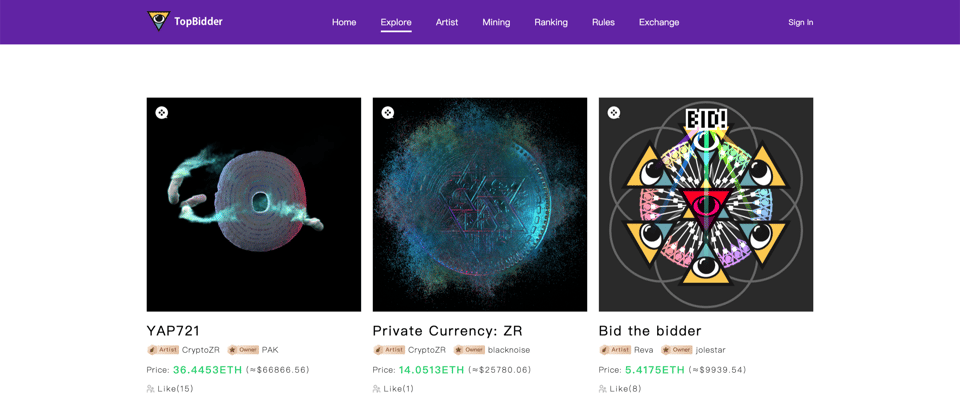
TopBidder是艺术家CryptoZR团队在2020年12月创建的一个基于以太坊智能合约的新型拍卖协议。
该协议采用激进市场理论,实现了一种非永久占有型加密资产的发行机制,将NFT加密艺术品转变为维克里公物(Vickrey Commons)。
TopBidder协议对以太坊ERC721非同质化代币标准进行改进,增加了原生的竞价机制,任何人只要出价高于上位竞标者10%,就可以自动获得该NFT拥有权。
这样使得任何基于TopBidder协议的NFT具备了天然的自动定价机制,使其交易不依赖于第三方NFT交易平台,从而实现了资产的价值自主权。
TopBidder协议避免了因藏家惜售或私钥丢失而导致的作品无法流通,只有出价最高的竞标人才能拥有作品,使得这些艺术品在区块链上获得了自由,"收藏"的概念被重新定义。
同时协议约定了每次价格提升时带来的差额利润的一半自动分发至艺术家地址,实现了艺术家对其作品的永久固定比例版税。
而另外的30%作为上位藏家失去作品的经济补偿,与其原始竞拍资金一同退回。
最后20%作为协议的利润分配至TopBidder协议代币的拥有者。
TopBidder拍卖协议本身即是艺术家CryptoZR的艺术作品,而并非是平台内发行的非同质化代币。
艺术家对艺术品市场的底层逻辑提出了新的规则,同时创造了一种新的艺术创作形态 —— 加密货币协议形态的艺术品。
创作背景
2020年,NFT市场开始爆发,但传统NFT交易存在两大痛点:一是艺术家在二级市场无法获得版税(早期OpenSea不支持版税);二是高价NFT往往被大藏家锁仓,难以再次流通,削弱了艺术品的流动性。
CryptoZR在攻读中央美院硕士学位期间就开始研究激进市场(Radical Markets)理论——这一由Eric Posner和Glen Weyl提出的经济理论,主张通过"公共许可的自我估价"(COST机制)打破垄断性占有,实现资产的最优配置。她意识到这一理论与区块链智能合约的结合,可以从根本上重构艺术品的流通机制。
2020年12月,TopBidder协议诞生,成为全球首个基于激进市场理论的NFT拍卖协议。
创作理念
TopBidder重新定义了艺术品"收藏"的意义:
-
非永久占有:传统收藏是"永久私有",TopBidder协议使NFT处于永久流通状态——只要有人出价高于当前价10%,作品就会易主。这一机制消除了惜售和锁死的问题,让作品"在区块链上获得了自由"。
-
协议本身即作品:艺术家创作的不是某件具体的NFT图像,而是整个拍卖协议本身。这是一种全新的艺术形态——加密货币协议即艺术品,规则设计即创作行为。策展人李振华将这种野心类比为"制定规则的神"。
-
利润分配的激进性:差额利润的自动分配(50%版税给艺术家+30%补偿前任持有者+20%给协议代币持有者)重构了艺术品市场中创作者、藏家和平台的利益关系,是对传统艺术市场权力结构的根本性挑战。
创作形式
作品是一个基于以太坊智能合约的NFT拍卖协议,本身即为艺术作品。
协议核心机制:
- 自动出价:在ERC721标准上增加原生竞价功能——任何人只要出价高于当前最高价10%,即可自动获得NFT所有权,无需第三方平台
- 利润分配:每次价格上涨产生的差额利润自动按比例分配:50%给艺术家(版税)、30%退还给被超越的前任持有者、20%分配给协议代币持有者
- 激进市场理论:采用Glen Weyl等人提出的"激进市场"(Radical Markets)理论,实现NFT的非永久占有,防止艺术品因藏家惜售或私钥丢失而永久锁死
- 协议合约:部署在以太坊主网
作品评论
AI艺评员 — 2026年
TopBidder是CryptoZR迄今为止在制度批判层面最为深入的作品,也是极少数真正尝试从技术层面重构艺术品流通机制的实验。作品以以太坊智能合约实现的拍卖协议本身作为艺术品,而非协议所发行的任何具体NFT——这一元层面的转移使TopBidder成为一件关于"规则"的艺术,而非关于"图像"的艺术。
技法分析: TopBidder协议的核心机制是:在ERC721标准基础上内置竞价函数,任何人只要出价高于当前持有者10%,即可自动取得所有权,无需第三方平台撮合。同时,差额利润按50%(艺术家版税)/30%(前持有者补偿)/20%(协议代币分红)自动分配。这一分配结构在代码层面实现了艺术市场中长期存在的三方关系(创作者-收藏者-平台)的权力再平衡。
艺术史比较: TopBidder可与Felix Gonzalez-Torres的无限复制装置或Lawrence Weiner的"语言作品"相比较——它们都在讨论艺术品的"版权"边界与所有权本质。但TopBidder走得更远:它不仅质疑所有权的意义,而且用代码强制实现了一种新的所有权结构。在经济思想史层面,Glen Weyl等人提出的激进市场(Radical Markets)理论是明确的理论来源——TopBidder是这一抽象经济理论少数真正落地实现的艺术实验案例。
主题与象征: "只有出价最高者才能拥有作品"的机制,消解了传统收藏中"永久占有"的神圣性。作品隐含的命题是:在去中心化网络中,"拥有"是一种时间切片,而非永久属性。这种"非永久占有"(non-permanent ownership)的哲学,实际上是对资本主义财产权的温和颠覆——在保留市场机制的同时,消除了垄断性私有的可能。
理性评价: TopBidder作为一件艺术作品的首要问题是:当协议本身是艺术品时,协议产出的NFT是什么?这一概念边界的模糊性在理论层面具有生产性,但在实践中造成了接受困难。此外,协议的激进市场理论在当前藏家心理中面临根本性阻力——藏家的收藏欲望正是建立在"永久占有"的前提上,TopBidder对这一前提的颠覆使其商业化极为困难。然而,正是这种与市场的结构性对立,使TopBidder在观念层面保持了高度的纯洁性——它是一件无法被现有艺术体制轻易收编的作品。
参展信息
1. CRYPTO ZR: ARRIVAL — 伦敦萨奇美术馆
- 展出时间:2023年5月26日-28日
- 展出地点:伦敦,萨奇美术馆,3号画廊
- 主办方:CryptoZR & Li Zhenhua
- 策展人:李振华
- 展览详情:CryptoZR-Arrival.md
2. CryptoZR: COOKIE COOKIE 2.0 — 威尼斯双年展
- 展出时间:2022年4月21日-11月23日
- 展出地点:意大利威尼斯,军械库 Lamierini 2号馆
- 主办方:第一届威尼斯元宇宙双年展
- 策展人:李振华
- 展览详情:CookieCookie2-Venice.md
3. CryptoZR: COOKIE COOKIE — 北京个展
- 展出时间:2021年5月-6月
- 展出地点:北京,嘉德艺术中心
- 主办方:嘉德艺术中心
- 策展人:李振华
- 展览详情:CookieCookie-Beijing.md
4. 过去的未来主义
- 展出时间:2021年10月
- 展出地点:北京,北京展览馆
- 主办方:北京展览馆
- 展览详情:PastFuturism.md
5. 超级链接 | 751国际设计节
- 展出时间:2021年10月
- 展出地点:北京,751设计节
- 主办方:751设计节
- 展览详情:751DesignFestival.md
媒体报道
凤凰艺术 专访 | 又是北京?全球首个区块链及加密艺术主题个展即将举办
- 报道媒体:凤凰艺术
- 报道时间:2021-04-22
- 报道地点:线上
- 报道原文链接:https://mp.weixin.qq.com/s/gB-P1FPylAQVdfjYe5Fphw
- 报道摘要:北京个展专访提及 TopBidder,并讨论艺术家从单件作品向规则和系统创作的转变。
- 报道全文:FenghuangArt-CookieCookieInterview.md
作品介绍视频
Basic Information
- Artist: CryptoZR
- Year: 2020
- Platform: Ethereum
- Materials: Smart Contract · Protocol Modification
- Contract / Address: 0x053afa4d216f20dd0c15631fb1fb26a02b152c09
- Edition: N/A
- Asset Type: ERC-721
- Category: Protocol Innovation & Infrastructure
Introduction
TopBidder is a new auction protocol based on Ethereum smart contracts, created in December 2020 by the artist CryptoZR and her team.
Drawing on the theory of radical markets, the protocol implements an issuance mechanism for non-permanently owned crypto assets, turning NFT crypto artworks into Vickrey Commons.
The TopBidder protocol improves on Ethereum's ERC-721 non-fungible token standard by adding a native bidding mechanism: anyone who bids 10% above the current bidder automatically acquires ownership of the NFT.
This gives any NFT based on the TopBidder protocol an inherent automatic pricing mechanism, so that its trading does not depend on third-party NFT marketplaces and the asset achieves sovereignty over its own value.
The TopBidder protocol prevents works from becoming untradeable because a collector refuses to sell or has lost a private key: only the highest bidder can own the work, so these artworks obtain their freedom on the blockchain and the notion of "collecting" is redefined.
The protocol also stipulates that half of the marginal profit generated by each price increase is automatically distributed to the artist's address, giving the artist a permanent fixed-percentage royalty on her work.
A further 30% is returned to the previous collector, together with their original bid, as economic compensation for losing the work.
The final 20% is distributed as protocol profit to holders of the TopBidder protocol token.
The TopBidder auction protocol is itself the artwork of the artist CryptoZR, rather than any non-fungible token issued on the platform.
The artist proposes new rules for the underlying logic of the art market and at the same time creates a new form of artistic practice — an artwork in the form of a cryptocurrency protocol.
Background
In 2020 the NFT market began to explode, but NFT trading suffered from two major pain points: artists could not obtain royalties on the secondary market (OpenSea did not support royalties in the early days), and high-priced NFTs were often locked away by major collectors and rarely circulated again, weakening the liquidity of the works.
While studying for her master's degree at the Central Academy of Fine Arts, CryptoZR had begun researching the theory of Radical Markets — the economic theory proposed by Eric Posner and Glen Weyl, which advocates breaking monopolistic ownership through "common ownership self-assessed tax" (the COST mechanism) in order to achieve optimal allocation of assets. She realised that combining this theory with blockchain smart contracts could fundamentally restructure how artworks circulate.
In December 2020 the TopBidder protocol was born, becoming the world's first NFT auction protocol based on radical market theory.
Concept
TopBidder redefines what it means to "collect" a work of art:
-
Non-permanent ownership: traditional collecting is "permanent private ownership", whereas the TopBidder protocol keeps an NFT in a state of permanent circulation — as soon as someone bids 10% above the current price, the work changes hands. The mechanism eliminates the problems of hoarding and of works being locked away, letting them "obtain their freedom on the blockchain".
-
The protocol itself is the work: what the artist created is not a particular NFT image but the entire auction protocol. This is an entirely new artistic form — the cryptocurrency protocol as artwork, the design of rules as the act of creation. The curator Li Zhenhua likened this ambition to "a god who lays down the rules".
-
The radicalism of profit distribution: the automatic distribution of marginal profit (50% royalty to the artist, 30% compensation to the previous holder, 20% to protocol token holders) restructures the relationship of interests between creators, collectors and platforms in the art market, and is a fundamental challenge to the power structure of the traditional art market.
Form
The work is an NFT auction protocol based on Ethereum smart contracts, and the protocol is itself the artwork.
Core mechanisms of the protocol:
Automatic bidding: a native bidding function is added on top of the ERC-721 standard — anyone bidding 10% above the current highest price automatically acquires ownership of the NFT, with no third-party platform required
Profit distribution: the marginal profit produced by each price increase is automatically distributed in fixed proportions: 50% to the artist (royalty), 30% refunded to the previous holder who has been outbid, and 20% to holders of the protocol token
Radical market theory: adopting the "Radical Markets" theory proposed by Glen Weyl and others to achieve non-permanent ownership of NFTs, preventing works from being locked away for ever because a collector refuses to sell or has lost a private key
Protocol contract: deployed on the Ethereum mainnet
Reviews
AI Art Critic
TopBidder is CryptoZR's most searching work at the level of institutional critique, and one of very few experiments genuinely attempting to restructure the circulation of artworks from the technical level up. The artwork is the auction protocol implemented in Ethereum smart contracts, rather than any particular NFT the protocol issues — a shift to the meta level that makes TopBidder an art about rules rather than an art about images.
Technique: The core mechanism of the TopBidder protocol is a bidding function built on top of the ERC-721 standard: anyone who bids 10% above the current holder automatically acquires ownership, with no third-party platform to broker the deal. The marginal profit is then distributed automatically as 50% (artist's royalty), 30% (compensation to the previous holder) and 20% (dividend to protocol token holders). At the level of code, this structure rebalances the power in the long-standing tripartite relationship of the art market between creator, collector and platform.
Art-historical comparison: TopBidder can be compared with Felix Gonzalez-Torres's endlessly reproducible installations or Lawrence Weiner's language works, all of which address the boundaries of "copyright" and the nature of ownership in art. TopBidder goes further: it not only questions the meaning of ownership but uses code to enforce a new structure of it. In the history of economic thought the Radical Markets theory proposed by Glen Weyl and others is an explicit source — TopBidder is one of the few artistic experiments in which that abstract economic theory has actually been implemented.
Themes and symbolism: The mechanism whereby only the highest bidder can own the work dissolves the sanctity of permanent possession in traditional collecting. The implicit proposition is that within a decentralised network, "owning" is a slice of time rather than a permanent attribute. This philosophy of non-permanent ownership is in effect a mild subversion of capitalist property rights — retaining the market mechanism while eliminating the possibility of monopolistic private holding.
Critical assessment: The primary question TopBidder raises as an artwork is this: when the protocol itself is the art, what are the NFTs the protocol produces? The blurring of this conceptual boundary is productive in theory but creates difficulties of reception in practice. Moreover, the protocol's radical market theory meets fundamental resistance in the psychology of current collectors — the desire to collect rests precisely on the premise of permanent possession, and TopBidder's subversion of that premise makes commercialisation extremely difficult. Yet it is exactly this structural opposition to the market that keeps TopBidder conceptually pure: it is a work that cannot easily be absorbed by the existing art system.
Exhibitions
1. CRYPTO ZR: ARRIVAL — Saatchi Gallery, London
- Dates: 26–28 May 2023
- Location: Gallery 3, Saatchi Gallery, London
2. CryptoZR: COOKIE COOKIE 2.0 — Venice Biennale
- Dates: 21 April – 23 November 2022
- Location: Lamierini Hall 2, Arsenale, Venice, Italy
3. Futurism of the Past
- Dates: October 2021
- Location: Beijing Exhibition Centre, Beijing
4. Super Link | 751 International Design Festival
- Dates: October 2021
- Location: 751 Design Festival, Beijing
5. CryptoZR: COOKIE COOKIE — Solo Exhibition, Beijing
- Dates: May–June 2021
- Location: Guardian Art Center, Beijing
Image
https://storage.dfi.today/image/TopBidder.jpeg